
What’s My FTP?
Upload one hard ride and get your Functional Threshold Power in seconds — plus a full cycling performance report. No login, no subscription, no 20-minute test in the pain cave.
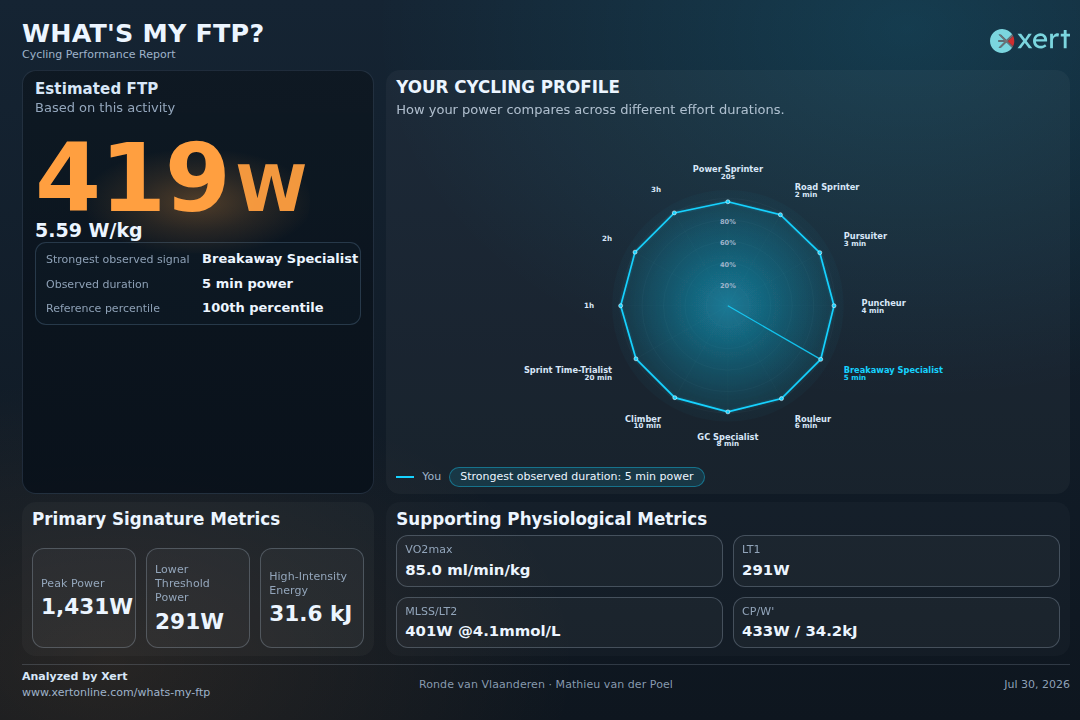
An actual report from the tool — Mathieu van der Poel’s winning ride from the 2022 Tour of Flanders. One FIT file in, your whole fitness signature out.
What is FTP?
FTP (Functional Threshold Power) is the highest power a cyclist can hold in a steady effort for about an hour, measured in watts. It’s the single most useful number for setting training zones, pacing races, and tracking fitness.
Traditionally you’d find it with a dreaded 20-minute all-out test. Xert’s What’s My FTP? tool skips the test: it reads the effort profile from a hard ride you’ve already done and estimates your FTP from how your power faded as you fatigued — using the same physiological model that powers Xert.
How it works
Pick a hard ride
Any race or hard workout with sustained efforts above threshold — ideally 2–3 minutes near your limit. Export it as a .fit file from Garmin, Wahoo, Zwift, or Strava.
Drop it in
Drag the file onto the tool. It’s analysed in seconds — nothing is saved to any account, no sign-up required.
Read your report
Get your FTP in watts and W/kg, your rider-type profile, and a full physiological breakdown — a complete performance report you can download and share.
FTP alone doesn’t win a cobbled classic
A race like the Ronde is decided by the sprint out of every corner and the size of your anaerobic tank. That’s Peak Power and High-Intensity Energy, and What’s My FTP? reads both straight from the ride — numbers a plain FTP calculator never shows.
These aren’t fresh-legs numbers. Van der Poel’s peak power that day landed at 6 hours 36 minutes into the race — the winning sprint, not a warm-up effort. His final 30 minutes averaged nearly double his first 30 (351 W vs 181 W).
That’s the effort his FTP, PP and HIE are built from: a rider producing his best power after hundreds of kilometres of racing, not before. It’s exactly what Xert’s fatigue-aware model is designed to read — power output as glycogen depletes, not just a number from a fresh-legs test.
Same free tool, from a WorldTour sprint to a Tuesday-night race — it measures the numbers that actually separate riders.
From a Tour of Flanders winner to a Tuesday-night Zwift race
Every report below came straight out of the tool — one FIT file each. Same free tool, whether you’re winning WorldTour classics or racing Cat C after work.
Mathieu van der Poel
MGCC Espresso Ride
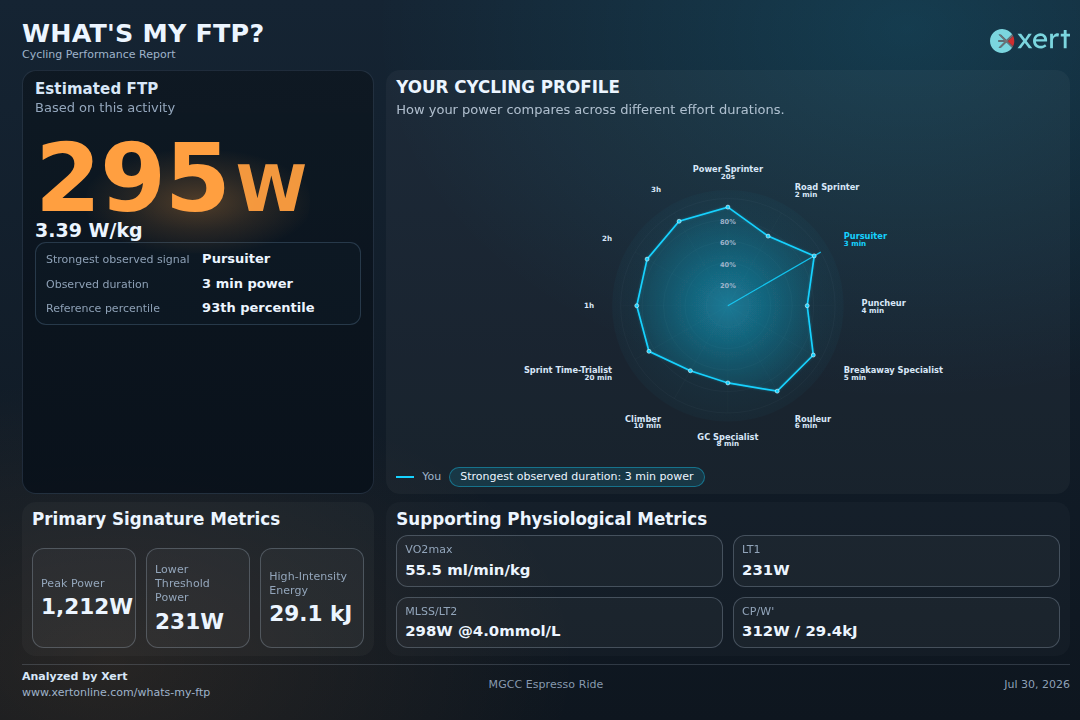
Cat-C Zwift racer
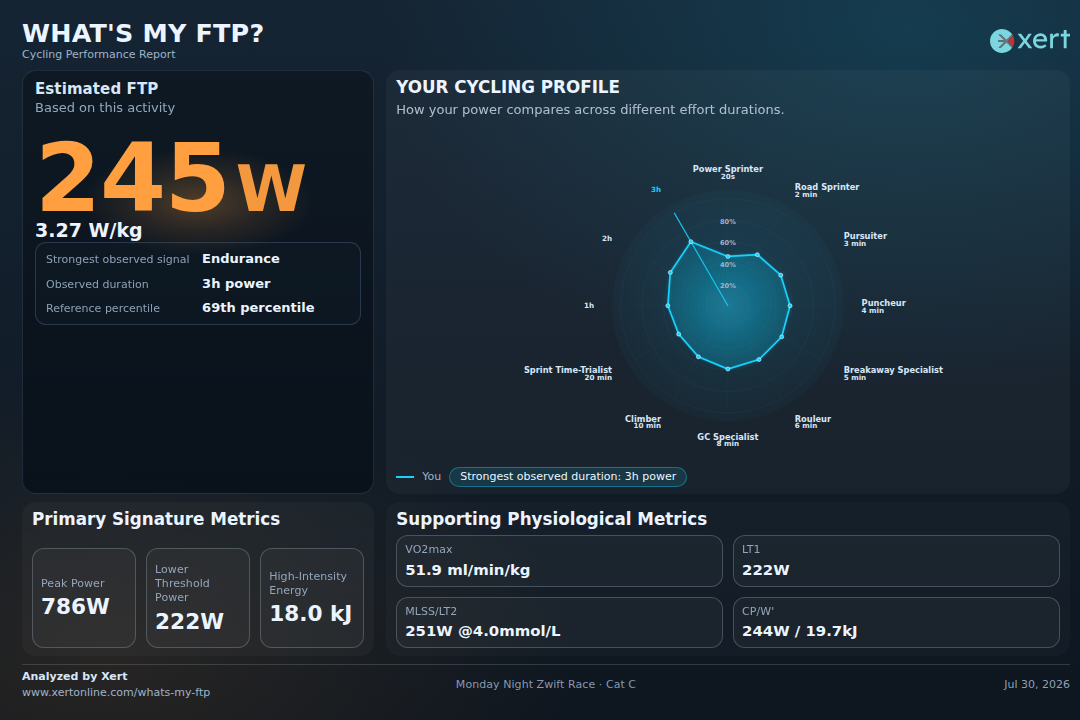
The pro report uses race-day fuelling settings (a subscriber option); the club and Zwift rides use the tool’s defaults. Same engine, dialled to the rider.
Comprehensive Fitness and Physiological Assessment
Most FTP calculators stop at a single watt figure. Xert reads your whole physiology from the ride.
Functional Threshold Power
Your sustainable hour power — the anchor for every training zone.
Peak Power
Your maximum neuromuscular sprint — the highest instantaneous power you can produce.
Lower Threshold Power
Your aerobic floor. Below it you burn mostly fat with almost no lactate build-up.
High-Intensity Energy
The size of your anaerobic “battery” in kJ — how much you have for attacks and surges.
VO₂max & VLaMax
Estimated maximal oxygen uptake and glycolytic rate — the engine behind the numbers.
MLSS & CP / W′
Maximal lactate steady state plus classic Critical Power and W′, for the model nerds.
See what your training could become
The free tool reads one ride. A Xert account reads your entire history — tracking your signature every day, adapting your workouts automatically, and telling you exactly when you’re ready to break through.
What’s My FTP? — FAQ
What is FTP in cycling?
FTP, or Functional Threshold Power, is the highest power output a cyclist can sustain for about one hour in a steady effort. It’s the standard reference for setting training zones and pacing.
How do I estimate FTP from a FIT file?
Upload a FIT file from a hard ride or race with sustained efforts above threshold. Xert’s model analyses how your power faded as you fatigued and returns an FTP estimate in watts, in seconds.
Do I need an account or subscription?
No. The tool is free and requires no login. Your ride is analysed to produce your estimate, and nothing is saved to any account.
What’s the difference between watts and W/kg?
Watts measure your raw power output — what matters most on flat roads. W/kg divides that by body weight, which is what counts when the road tilts up. Every report gives you both.
What kind of ride gives the best estimate?
A hard ride or race with sustained efforts above FTP for at least two to three minutes, where you eventually reach your limit. Steady endurance rides give the model less to work with.
Is a single-ride FTP estimate accurate?
It’s an excellent quick check. For the most accurate, continuously-updated picture, a full Xert account analyses your entire training history rather than one ride.